
MUSICALIA · SPECIAL
THE BEATLES
The complete story of the Liverpool quartet
From the cellars of Hamburg to the rooftop of Apple. Ten years, thirteen albums, and a revolution that split the history of popular music in two. Scroll to travel through a decade.
John Lennon · Paul McCartney · George Harrison · Ringo Starr
The crucible
Before fame came 1,200 hours on stage and a port full of drunken sailors.
It all started on July 6, 1957, at a church social at St. Peter's Church in Woolton. A teenager named Paul McCartney watched a skiffle band, The Quarrymen, led by a 16-year-old John Lennon, play. That afternoon a friend introduced them: Paul impressed John by tuning a guitar and playing rock and roll from memory. A few months later, a younger guitarist joined, George Harrison, who earned his place by playing a complete solo on the upper deck of a bus.
Liverpool was no ordinary city for this. An Atlantic port facing America, it received rock and roll, blues, and rhythm & blues records that sailors brought before they ever played on British radio. Those imported vinyl records—Elvis, Little Richard, Chuck Berry, Carl Perkins, Motown girl groups—were the true schooling of four obsessed teenagers.
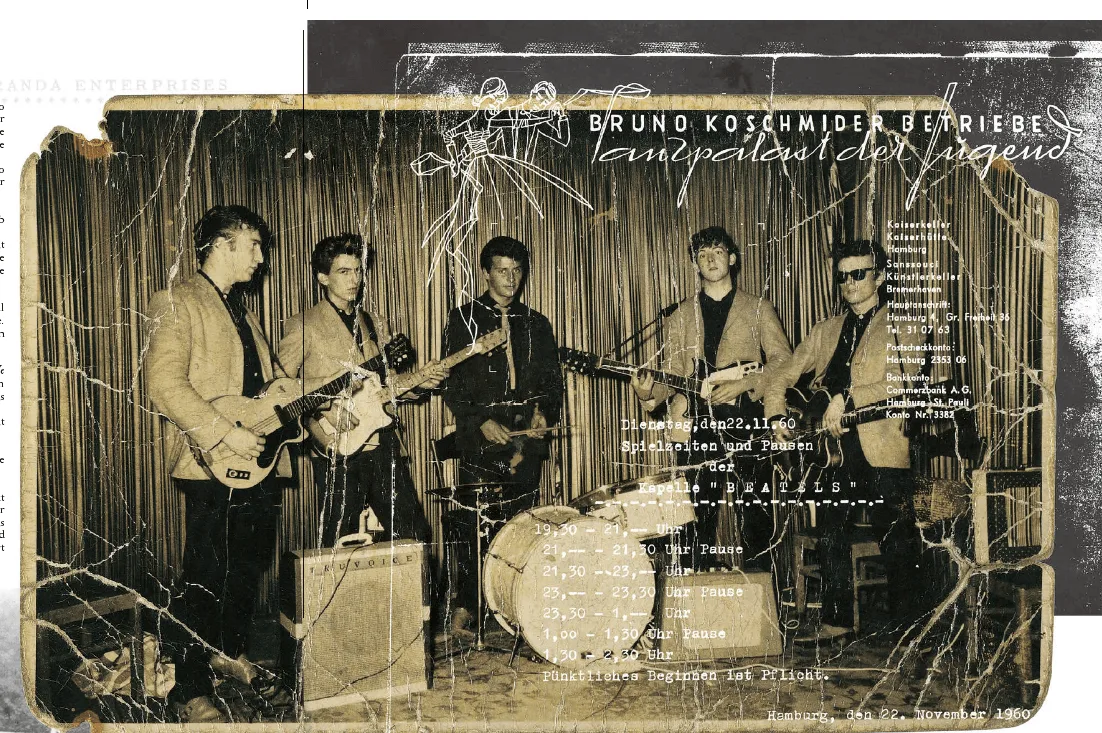
But the group's definitive university was Hamburg. Between 1960 and 1962, the owners of the red-light district clubs on the Reeperbahn—the Indra, the Kaiserkeller, the Star-Club—forced them to play up to eight hours straight, from midnight to dawn, for audiences of sailors who would end up fighting without music. "Mach Schau!" (Make a show!), they would shout. John, Paul, George, bassist Stuart Sutcliffe, and drummer Pete Best accumulated more than 1,200 hours on stage there—roughly 250 nights. Shouting to keep a drunken audience, surviving on amphetamines and little sleep, the sharpest musical machine in rock was forged.
In Hamburg, photographer Astrid Kirchherr—Sutcliffe's girlfriend—cut their hair into that fringe that would conquer the world, and photographed them with an existentialist elegance that defined their first image. Stuart left the band to paint and died of a cerebral hemorrhage in 1962, at age 21. Paul moved to bass, the instrument he would play his entire life.
The final cog was put in place by an elegant Liverpool record merchant, Brian Epstein, who saw them in the damp basement of the Cavern Club in November 1961 and decided they would be "bigger than Elvis". He got them an audition at Decca on New Year's Day 1962—which the record label rejected with the most expensive line in history: "guitar groups are on the way out"—. Epstein insisted until George Martin at EMI opened the studio door for them. And in August 1962, Pete Best was replaced by a drummer from another local band, Richard Starkey, alias Ringo Starr. The classic lineup was finally complete.
“We weren't good when we arrived in Hamburg. We were good when we left.”
— John Lennon
Beatlemania is born
They recorded their first album in a single day. Within months, an entire country was screaming their name.
On February 11, 1963, in a marathon of about ten hours in Studio Two at Abbey Road, The Beatles recorded nearly their entire first album, "Please Please Me". They did it on a two-track recorder, almost live, to capture the energy of their Cavern shows. Lennon closed the session by shredding his throat on "Twist and Shout", recorded in one take because he had no voice left—and you can hear it. Producer George Martin, who would soon be dubbed "the fifth Beatle", knew he had something unprecedented in his hands.
What followed was unprecedented. "From Me to You", "She Loves You"—with its contagious "yeah, yeah, yeah"—and "I Want to Hold Your Hand" strung together number ones and sold millions. The novelty wasn't just the music, but that they wrote most of the songs themselves: the Lennon-McCartney duo, something extremely rare for a pop group of the era, which relied on professional songwriters.
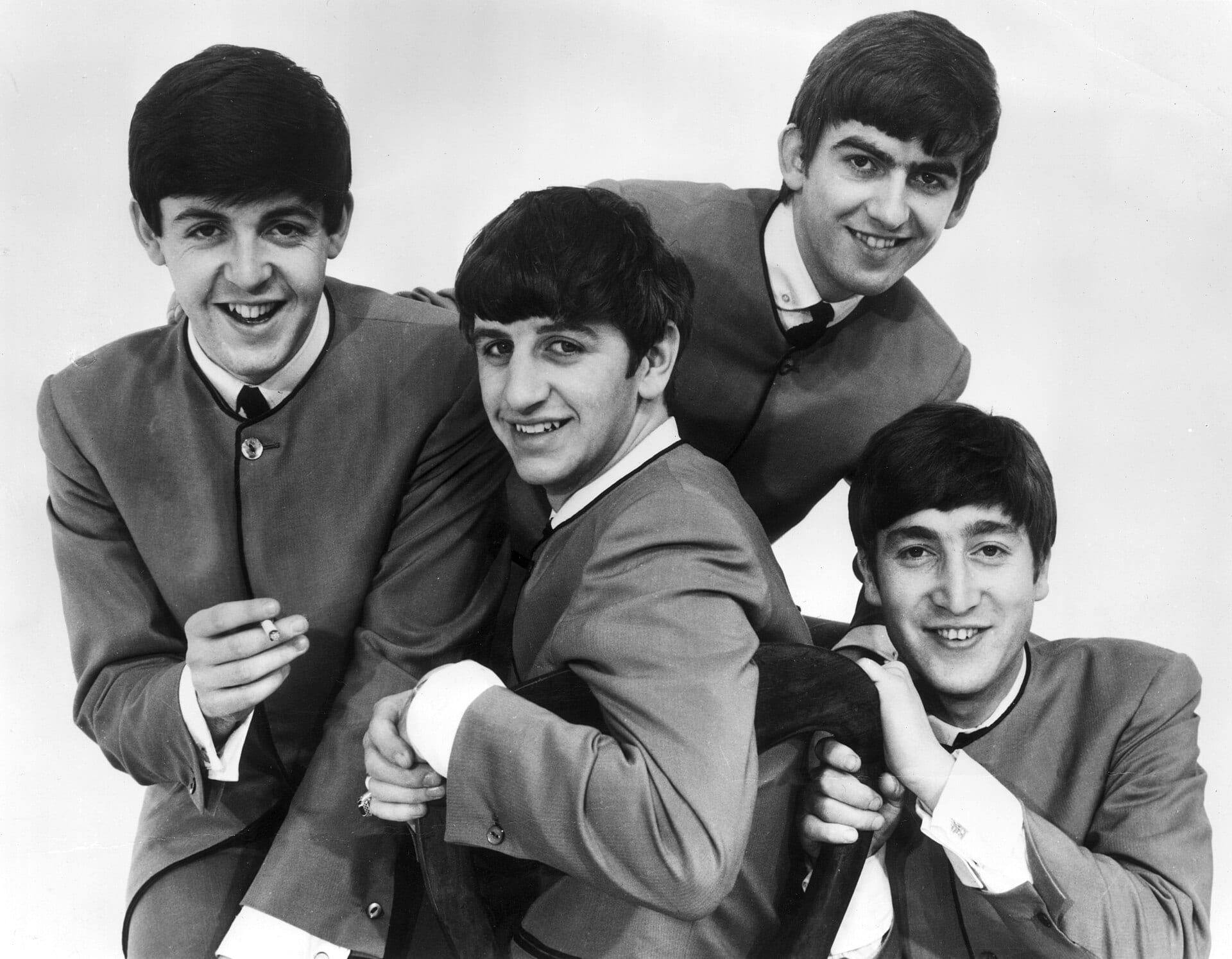
Their second album, "With the Beatles", came out that same November with a cover of halved faces in black and white, photographed by Robert Freeman, that became as iconic as it was austere. The press christened the phenomenon "Beatlemania": crowds of teenagers who cried, fainted, and screamed so loudly they drowned out the band itself.
At the Royal Variety Performance, before British royalty, Lennon delivered his famous charming provocation before "Twist and Shout". In barely a year, four working-class boys from a declining port city had become the center of gravity of British youth culture. But the Atlantic Ocean still hadn't fallen.
“Those in the cheap seats, clap. The rest of you, rattle your jewelry.”
— John Lennon · Royal Variety Performance, 1963
Please Please Me
Photograph by Angus McBean on the EMI staircase
Proceso técnico
Recorded almost entirely in a single day of ~10 hours, on two tracks. The idea was to capture the raw energy of their concerts on vinyl. It cost about £400.
With the Beatles
Cover by Robert Freeman · chiaroscuro
Proceso técnico
Their second album in seven months. The half-faces in shadow are inspired by Astrid Kirchherr's existentialist photos in Hamburg. It sold a million copies.
The conquest of America
73 million people in front of the television. The British Invasion started on a Sunday in February.
On February 7, 1964, when the plane landed at the newly renamed JFK Airport, thousands of fans waited screaming behind the barriers. The United States was recovering from a trauma: the assassination of President Kennedy just eleven weeks before. The Beatles arrived as an injection of color and joy to a grieving nation, and the timing couldn't have been more perfect.
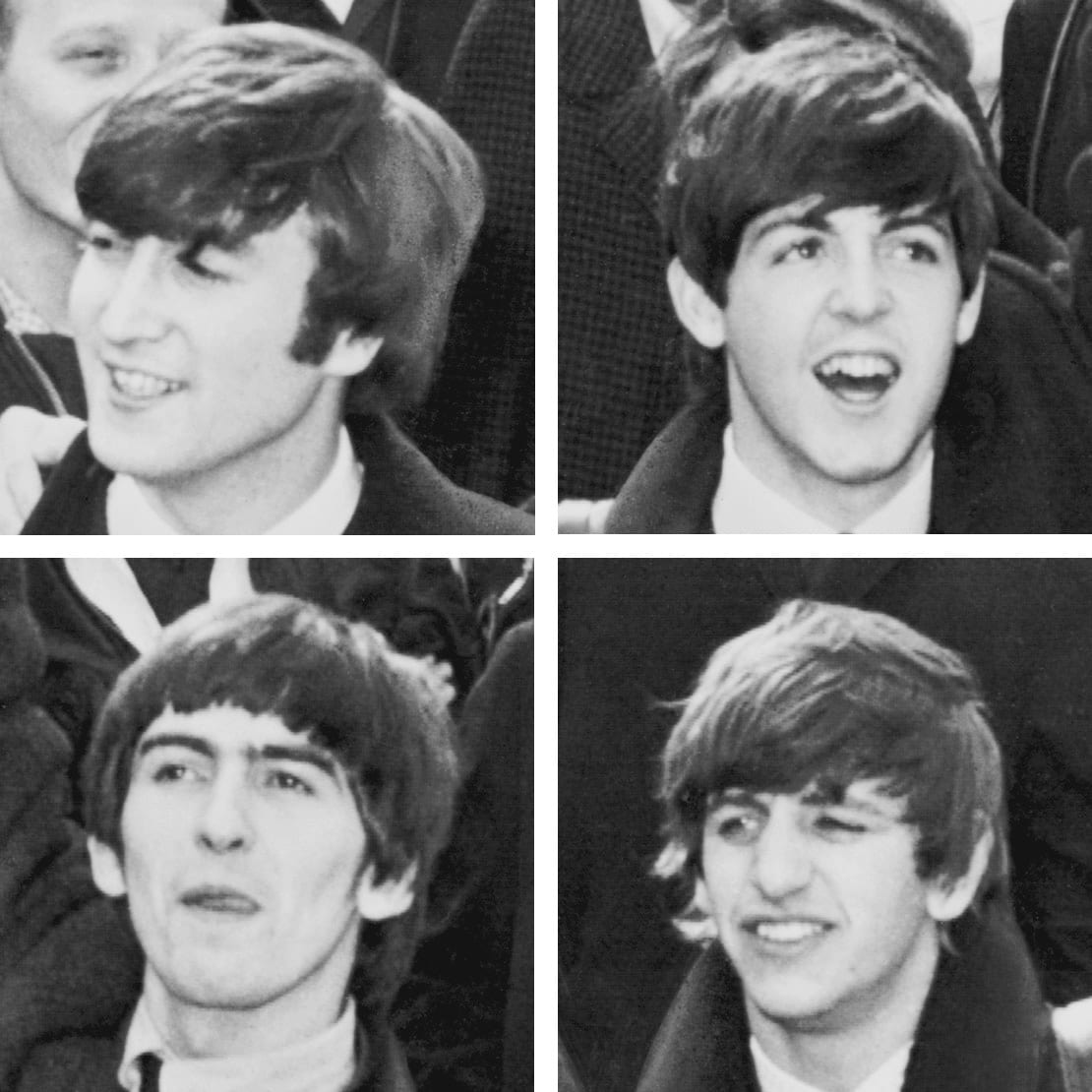
Two days later, on February 9, they performed on Ed Sullivan's program before about 73 million viewers—the largest television audience in American history at that time. It's said that night juvenile delinquency hit historic lows: every American teenager was in front of the TV. An entire generation of future musicians—from Springsteen to Tom Petty—would later swear that their lives changed that night.
In April something happened that has never been repeated: The Beatles simultaneously occupied the top five positions on the Billboard Hot 100. Not first and third: all five. The band also dominated a dozen more positions on the chart. No commercial force in the history of music had ever had such absolute dominance of the largest market in the world.
That same year they premiered their first film, "A Hard Day's Night", a dizzying comedy that director Richard Lester shot in black and white with documentary energy and invented, without knowing it, the language of the modern music video. The homonymous album was the first composed entirely by Lennon and McCartney, and consecrated the metallic sheen of George Harrison's twelve-string Rickenbacker guitar—that opening chord, impossible to identify, which musicians still argue about today. At year's end, exhausted by the endless tour, they delivered "Beatles for Sale", a more tired, country-tinged album, with their haggard faces on the cover.
“Four guys playing and singing, writing their own songs... they opened up a whole world of possibilities.”
— Bruce Springsteen · on seeing the Beatles
A Hard Day's Night
Mosaic of film stills
Proceso técnico
First album 100% composed by Lennon-McCartney and soundtrack to their film. Debut of Harrison's 12-string Rickenbacker and its famous, enigmatic opening chord.
Beatles for Sale
Autumn portrait by Robert Freeman
Proceso técnico
Recorded between tours, in a hurry. The exhaustion shows: more rock and country covers, and a darker, more mature tone that emerges in songs like "I'm a Loser".
Something more than pop
They performed for 55,000 people and, at the same time, began to write like adults.
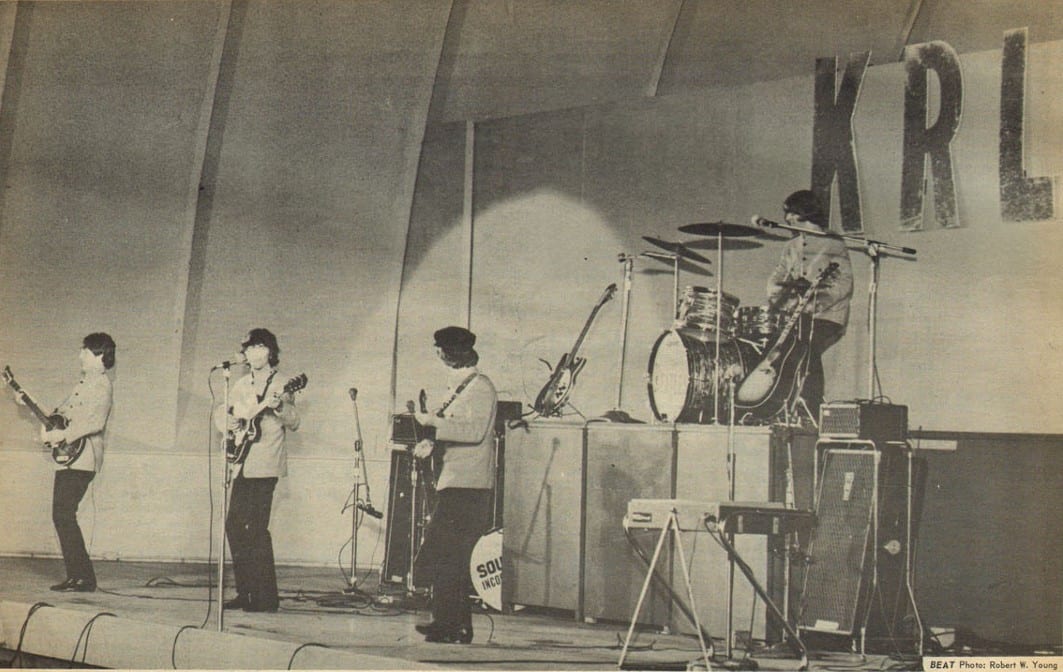
On August 15, 1965, The Beatles opened the era of massive concerts playing for more than 55,000 people at New York's Shea Stadium. It was glorious and absurd at the same time: the screams were so deafening that neither the audience nor the band could hear a single note, and they played through the precarious loudspeakers of the baseball stadium. That contradiction slowly began to push them toward the exit of the stage. That year the Queen named them Members of the British Empire (MBE), a scandal for conservatives who returned their medals in protest.
Meanwhile, in the studio they were growing at breakneck speed. "Help!" showed a confessional Lennon—"the song was a real cry for help," he would admit years later. But the leap was "Rubber Soul" (1965): the first album conceived as a unified work rather than a collection of singles, influenced by Bob Dylan, marijuana, and The Byrds' folk-rock.
"Norwegian Wood" introduced the Indian sitar into a Western pop song for the first time, the fruit of George Harrison's fascination with Indian music. They began to experiment with diffuse bass, multi-voice harmonies, electric piano, and introspective lyrics like "In My Life", a meditation on memory and lost friends that many consider among the most beautiful ever written.
And there was "Yesterday". The complete melody appeared in Paul McCartney's mind when he woke up one morning, so perfect that he spent weeks humming it to his friends, convinced he had accidentally stolen it from somewhere. Recorded with just his voice, an acoustic guitar, and a string quartet arranged by George Martin—something unheard of for a rock band—it became the most covered song in the history of popular music, with more than 2,000 registered covers.
“I woke up with this lovely tune in my head. I thought: "Does this exist? I've never written this before."”
— Paul McCartney · about "Yesterday"
Help!
The band spelling out in semaphore
Proceso técnico
Soundtrack to their second film. "Yesterday" appears here: voice, guitar, and a string quartet arranged by George Martin—the first time a Beatle recorded essentially alone.
Rubber Soul
Distorted photo · wide-angle lens
Proceso técnico
The first album conceived as a unified work, not as a showcase for singles. Features the sitar in pop ("Norwegian Wood"), diffuse bass, and adult lyrics. The stretched cover was a projection "accident" they decided to keep.
In My Life (Take 1)
The Beatles · Rubber Soul session · Anthology
The last concert
They stopped playing live forever—and opened the door to experimental art.
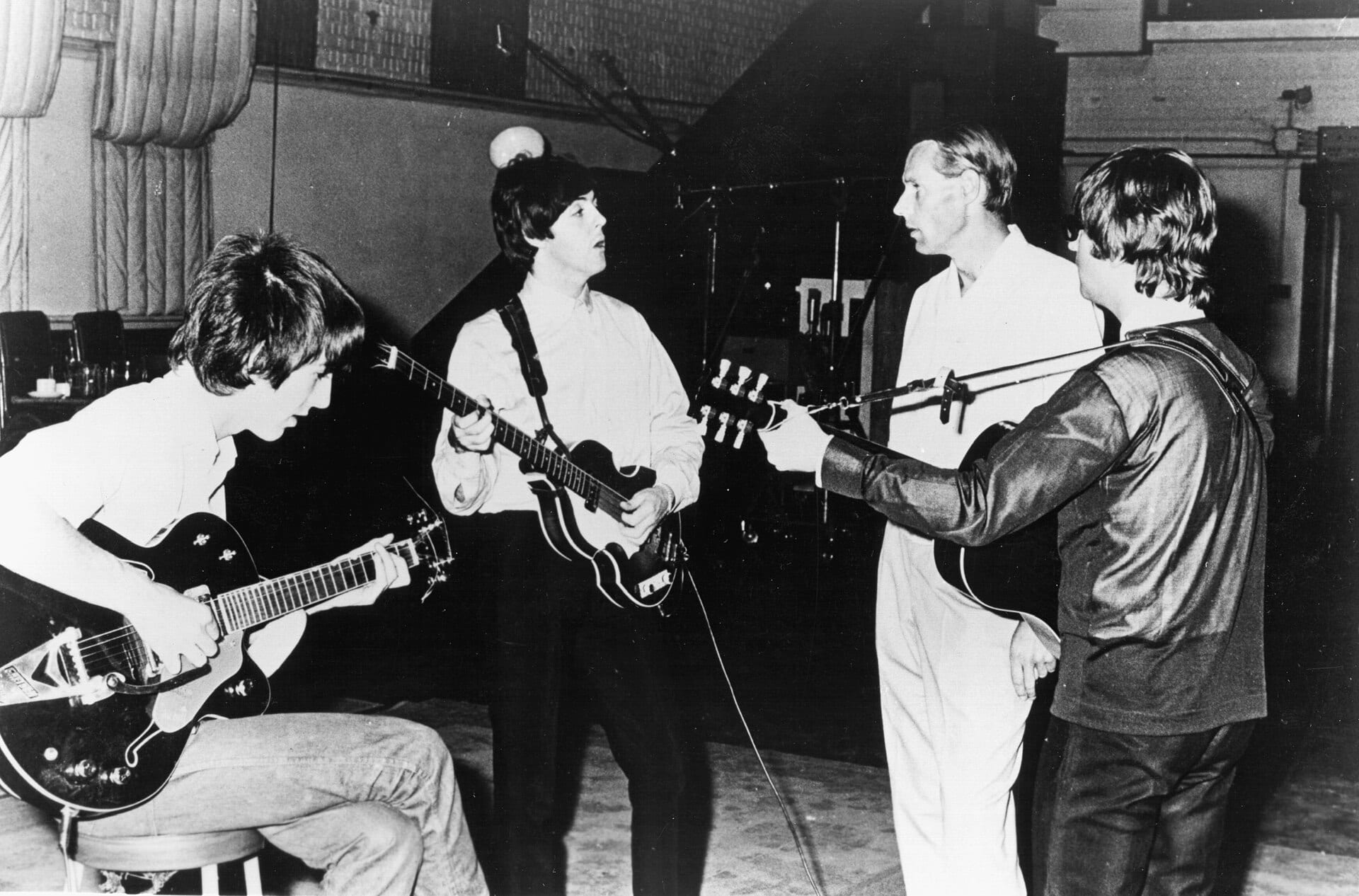
In 1966 everything tensed up. A quote from Lennon taken out of context—that The Beatles were "more popular than Jesus"—unleashed public record burnings in the United States, threats from the Ku Klux Klan, and radio bans. Add to that the exhaustion of playing for stadiums where people only screamed, where their music could no longer be heard. On August 29, 1966, they gave their last paid concert at Candlestick Park in San Francisco. They would never tour again.
Freed from the stage, they locked themselves in Abbey Road and turned the studio into an instrument. "Revolver" (1966) was the definitive leap. With young engineer Geoff Emerick experimenting without rules—and breaking several of EMI's internal norms—they invented techniques that would change recording forever: ADT (automatic double tracking, devised by Ken Townsend so Lennon wouldn't have to sing the same thing twice), guitars recorded backwards in "I'm Only Sleeping", Lennon's voice run through a rotating Leslie organ speaker in "Tomorrow Never Knows", and microphones placed inside the bass drum for a sound never before heard.
Psychedelia entered through the laboratory door. "Tomorrow Never Knows" puts Ringo on a single hypnotic drum loop while five tape loops—recorded by the band in their homes and mixed live by multiple hands over the consoles—float like electronic seagulls, and Lennon recites the Tibetan Book of the Dead asking to sound "like a thousand monks singing".
"Eleanor Rigby", on the other hand, has not a single rock instrument: it's a double string quartet arranged by George Martin, inspired by film composer Bernard Herrmann, over lyrics of solitude and death unthinkable in a pop hit. Critic Ian MacDonald, in "Revolution in the Head", considers "Revolver" the album where the band stopped being the most refined product of the entertainment industry to become, without caveats, artists. The rule that an album had to document a real concert had just been broken forever.
“We're not going to tour anymore. That's it. Now we're a studio band.”
— George Harrison, 1966
Revolver
Ink collage by Klaus Voormann
Proceso técnico
The laboratory. Premieres ADT (automatic doubling), backwards tape, voice through Leslie speaker, and homemade tape loops. The collage cover was designed by Klaus Voormann, a friend from the Hamburg days.
Sgt. Pepper and psychedelia
They invented an imaginary band, recorded a masterpiece, and broadcast it to the world all at once.
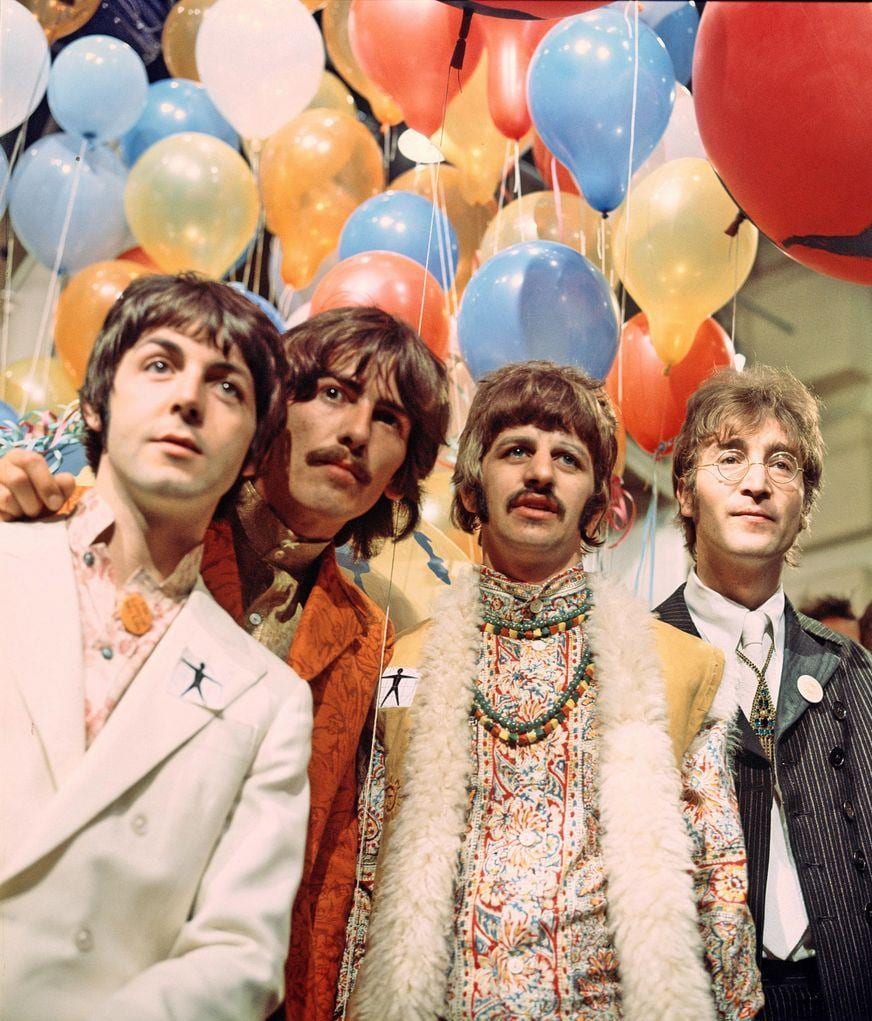
On June 1, 1967, "Sgt. Pepper's Lonely Hearts Club Band" came out, perhaps the most influential album ever recorded. They spent about 700 hours in the studio, spread over five months (compared to the ten hours their debut took). The idea—that the Beatles would pretend to be another band, a fairground military orchestra—gave them total freedom to experiment and become someone else. The result was a sonically unified journey from beginning to end, with no gaps between songs: the concept album brought to the masses.
Technically it was an archaeological feat: everything was recorded on machines with just four tracks. To gain space, they would mix and "bounce" tracks onto each other over and over (reduction mixing), losing a bit of quality in exchange for almost infinite layers. They synchronized two tape recorders by hand to achieve eight improvised tracks. They used harpsichords, carnival organs cut up and reassembled at random with scissors, and even a dog whistle that only you'll hear if your pet is nearby.
The closer, "A Day in the Life", adds an orchestra of forty musicians to which Martin asked to rise from their lowest note to their highest, each at their own pace, creating a terrifying crescendo of chaos; it ends with a piano chord played by several hands across three pianos and sustained for almost a minute, captured by raising the faders until you hear the studio air conditioning. It was also the first rock album to print all the lyrics on the cover.
That cover—a collage by Peter Blake and Jann Haworth with dozens of cardboard characters, from Marx to Marilyn—became as iconic as the music. On June 25, The Beatles performed "All You Need Is Love" on "Our World", the first live satellite broadcast to the entire planet: about 400 million people in 25 countries. It was the peak of the Summer of Love. But two months later, on August 27, their manager Brian Epstein died from an accidental pill overdose. He was 32. Without the man who had ordered the chaos, the group was, for the first time, adrift.
“It was a time when we all trusted each other and we were flying very high.”
— Paul McCartney · about 1967
Sgt. Pepper's Lonely Hearts Club Band
Collage by Peter Blake and Jann Haworth
Proceso técnico
About 700 hours of studio time on 4-track machines, with constant "bouncing" to stack layers. No gaps between tracks, lyrics printed, and the legendary collage cover.
Magical Mystery Tour
The Beatles dressed as animals
Proceso técnico
Soundtrack to their chaotic TV film. Includes "Strawberry Fields Forever": Martin joined two takes at different tempos and pitches, speeding up one and slowing down the other until they matched by chance.
All You Need Is Love (live, 1967)
The Beatles · Our World · worldwide satellite broadcast
Cracks in the ideal
They searched for peace in India and returned with 30 songs—and the first fractures.
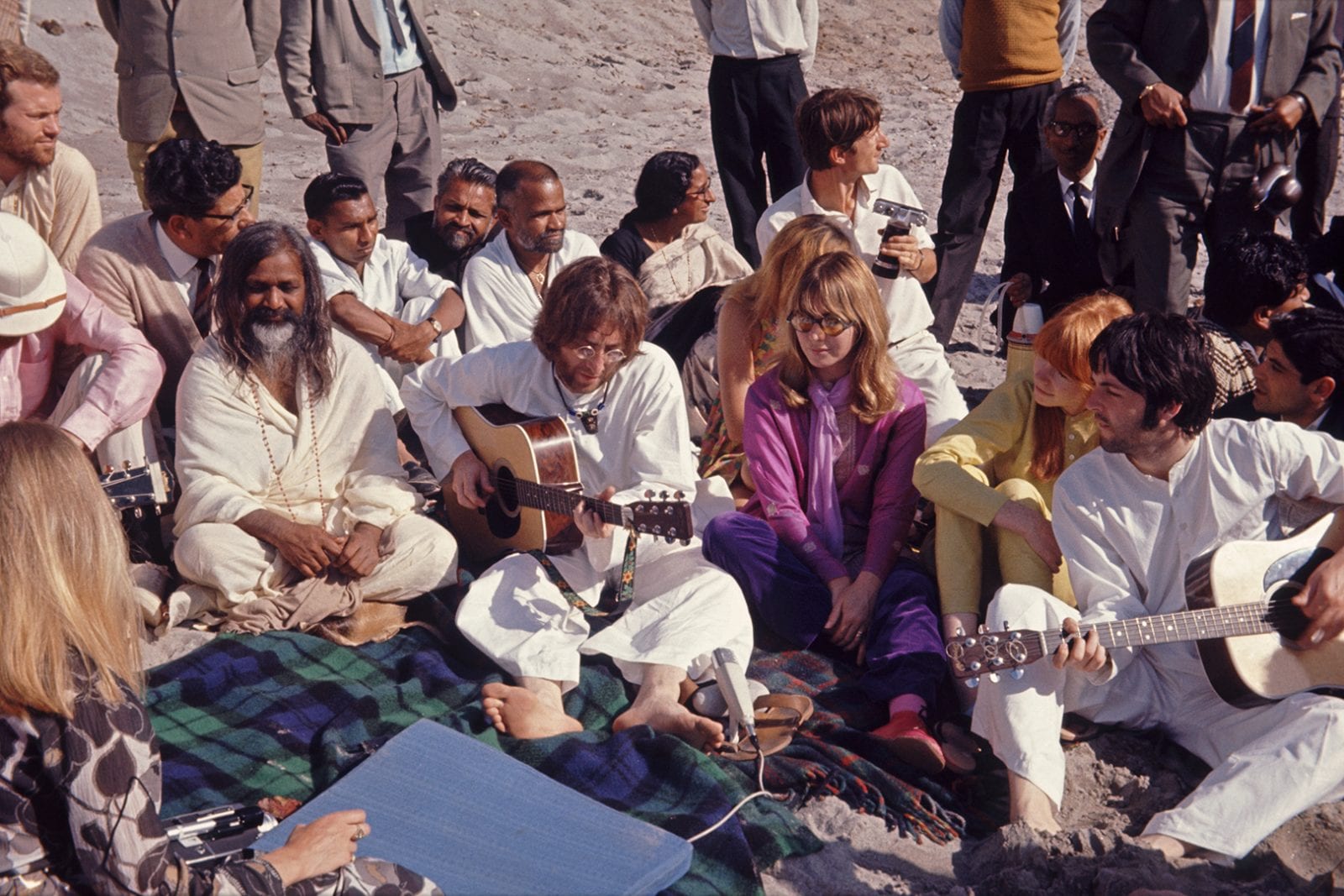
In early 1968 they traveled to Rishikesh, India, to study transcendental meditation with Maharishi Mahesh Yogi. The retreat, away from pressure and drugs, unleashed a creative explosion: they wrote dozens of songs—many acoustic, sitting in the sun with Donovan and Mia Farrow—that would form the double album "The Beatles", known forever as "The White Album".
Its cover, designed by pop artist Richard Hamilton, was the exact opposite of the ornate Sgt. Pepper: pure white, with only the band's name in relief and an individual serial number stamped on it, as if each copy were a numbered and signed work of art. Less was more.
But unity began to crack. Each one wrote more on their own, using the others almost as session musicians; sometimes they recorded in different rooms at once. Finally came the eight-track recorder, which gave the sound more space. Tensions over control of their new chaotic company, Apple Corps, and the constant presence of Yoko Ono in the studio—which broke an unwritten rule—made the atmosphere tense. Engineer Geoff Emerick quit midway through the sessions; Ringo Starr even abandoned the band for two weeks, fed up with the climate. When he returned, he found his drums covered with welcome flowers.
Still, the genius remained intact and overflowing: from the raw blues of "Yer Blues" to the musique concrète collage of "Revolution 9", from the sweet waltz of "Good Night" to the proto-metal of "Helter Skelter". George Harrison flourished with "While My Guitar Gently Weeps", for which he invited his friend Eric Clapton to play the lead guitar—unheard of, a stranger in a Beatles session. And that year they released "Hey Jude", over seven minutes long with a four-minute choral crescendo, which became the best-selling single of their career. The band was breaking apart and, at the same time, signing some of its peaks.
“The White Album was the beginning of the end. It was John's music and Paul's and George's.”
— George Martin
The Beatles (White Album)
Richard Hamilton · white with serial number
Proceso técnico
Double album of 30 songs written largely in India. First album to use the 8-track recorder, well into the sessions. The minimalist white numbered cover was a deliberate response to Sgt. Pepper's excess.
Hey Jude
The Beatles · 1968 · official video
While My Guitar Gently Weeps
The Beatles · White Album · official visualizer
The last goodbye on the roof
They played live for the last time on a London rooftop and said goodbye with their most perfect album.
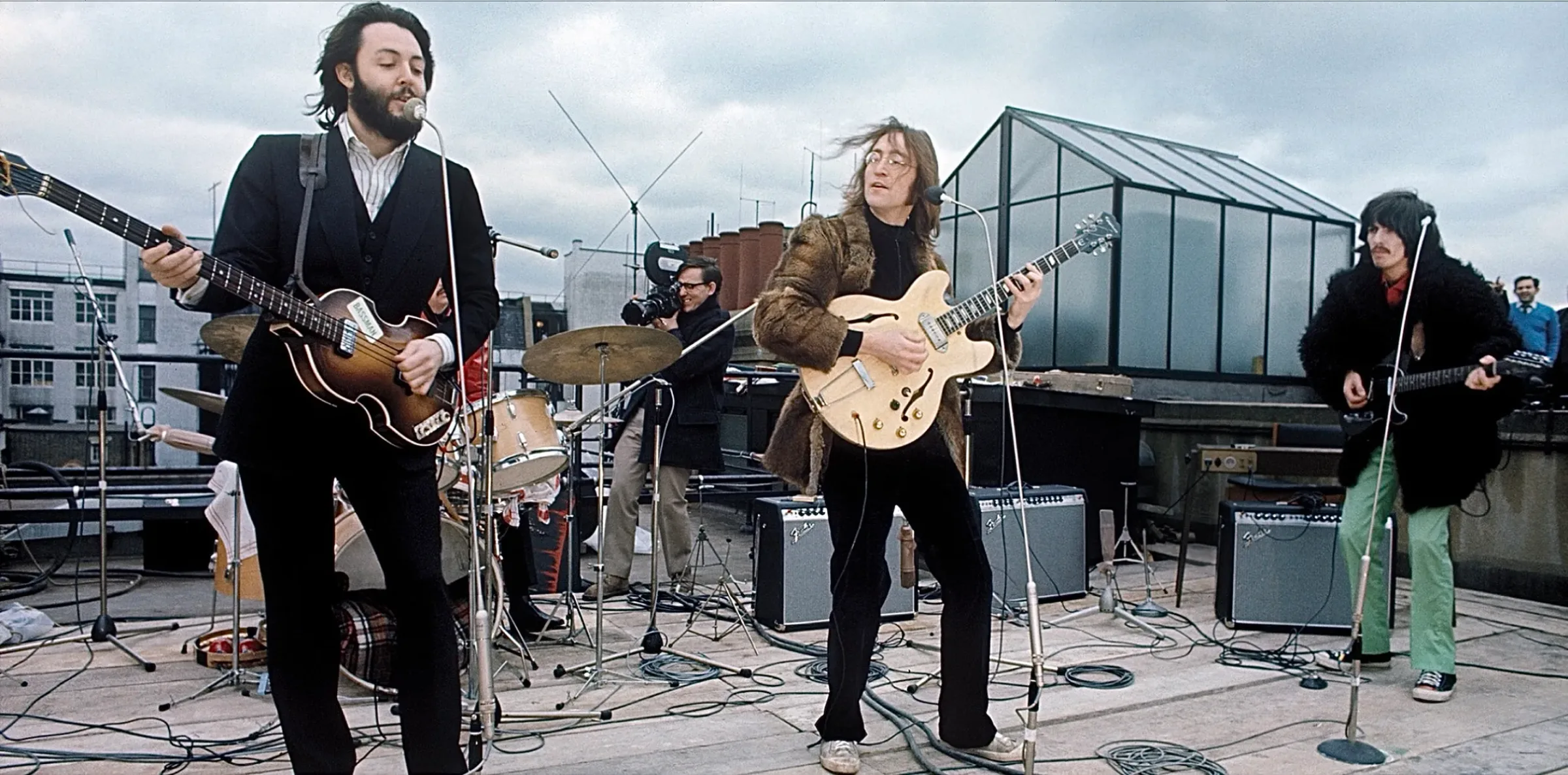
On January 30, 1969, without warning, The Beatles climbed to the roof of their Apple headquarters at 3 Savile Row and gave an impromptu concert of about 42 minutes to astonished London office workers, who were looking out from neighboring rooftops. The police ended it because of noise complaints. No one knew it yet, but it was the last time the four played together in public. The sessions for that project, tense and filmed for a documentary, would later be released as "Let It Be".
Aware that the end was near, they decided to record one last album "like the old days", with George Martin back in charge and all their technical weapons. The result was "Abbey Road" (1969), the first they recorded on eight real tracks and the first to use a Moog synthesizer—a wall-sized contraption that George Harrison had brought from California: its hum runs through "Here Comes the Sun", "Because", and "Maxwell's Silver Hammer".
Side B is the pinnacle of collaboration: a medley of eight fragments of unfinished songs, strung together without pause—a deliberate farewell sewn together by McCartney and Martin—that culminates in "The End", with Ringo's only drum solo in the entire catalog, a duel of guitars between Paul, George, and John, and one of the last phrases they recorded together: that the love you receive is, in the end, equal to the love you give.
The cover, the four crossing the zebra crossing in front of the studio, was shot by Iain Macmillan standing on a ladder in just ten minutes, with six photos and a cop stopping traffic. No text, no band name: it was no longer needed. It became the most imitated image in rock history—and fueled the absurd legend that Paul had died. It was a three-minute photo. It was also a funeral.
“In the end, the love you take is equal to the love you make.”
— The Beatles · "The End", Abbey Road
Abbey Road
Iain Macmillan · the zebra crossing
Proceso técnico
Their farewell and most polished album. The first recorded entirely on 8 tracks and the first with Moog synthesizer. The Side B medley chains eight unfinished songs into a single suite.
Two of Us
The Beatles · "Let It Be" sessions, 1969
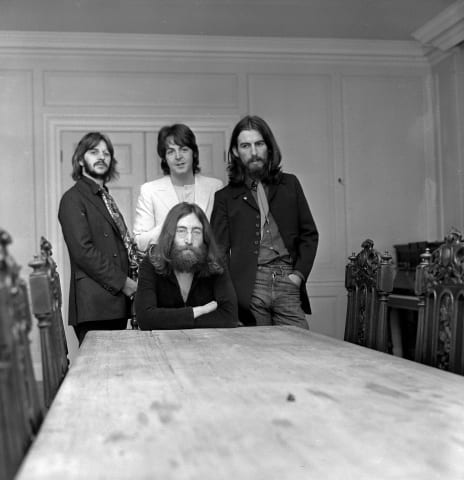
The end, and all that remained
They broke up at ages 27, 28, 29, and 29. They had been together for less than a decade. They changed the world forever.
On April 10, 1970, Paul McCartney announced he was leaving The Beatles, in a press release that accompanied his first solo album. The band had been falling apart internally for months—disputes over management, over Apple, over control—but it was his announcement that made it official to the world.
The following month "Let It Be" came out, recorded mostly before "Abbey Road": an album meant to be a raw return to roots that ended up handed to producer Phil Spector, whose string arrangements and choirs on "The Long and Winding Road" infuriated McCartney and symbolized, in a single song, everything that no longer worked between them. Western culture experienced the breakup like the death of a government or a shared religion. In his last major interview, Lennon summed it up in four words: "the dream is over".
They had been together as a worldwide band for less than ten years. In that time they redefined what a pop song could be, what an album could be, what a recording studio could be, and even what a rock band could be. Critic Ian MacDonald wrote that the Beatles are the best argument that exists for maintaining that popular music is a major art form: not for being technically perfect, but because they synthesized in three-minute songs the entire hopes and contradictions of their era.
John Lennon was shot and killed outside his home in New York in 1980, at age 40. George Harrison died of cancer in 2001. Paul and Ringo continue to perform, and in 2023, with the help of artificial intelligence to rescue an old demo with John's voice, they released "Now and Then", called "the last Beatles song". More than half a century after their breakup, their records continue to play, generation after generation, as if they had just been recorded. Since Beethoven nothing like that has happened: that a single artist contained, alone, the totality of his time.
“The dream is over. What can I say? The dream is over.”
— John Lennon, 1970
Let It Be
Four portraits on a black background
Proceso técnico
Conceived as a raw return "live", it was archived for a year. Phil Spector remixed it with strings and choirs—especially on "The Long and Winding Road"—a decision McCartney hated his entire life.
Let It Be
The Beatles · 1970 · restored official video
«El sueño ha terminado»
Estuvieron juntos menos de diez años. En ese tiempo reinventaron qué podía ser una canción, un álbum y un estudio de grabación. Sus discos siguen sonando como si acabaran de grabarse.
🎸 ¿Cuánto recuerdas? Juega el quiz☕ ¿Te gustó Musicalia? Apóyanos con una donaciónFotografías: archivo histórico y de prensa de la época —Wikimedia Commons (dominio público) junto a fotógrafos y agencias como Dezo Hoffmann, Astrid Kirchherr, Alec Byrne, UPI y Associated Press—, reproducidas con fines educativos y de divulgación; los derechos pertenecen a sus respectivos autores. Videos: canal oficial de The Beatles en YouTube. Carátulas: sus respectivos sellos. Un especial de Musicalia.
Hecho con cariño por Felipe Acuña Viera · Musicalia · 2026